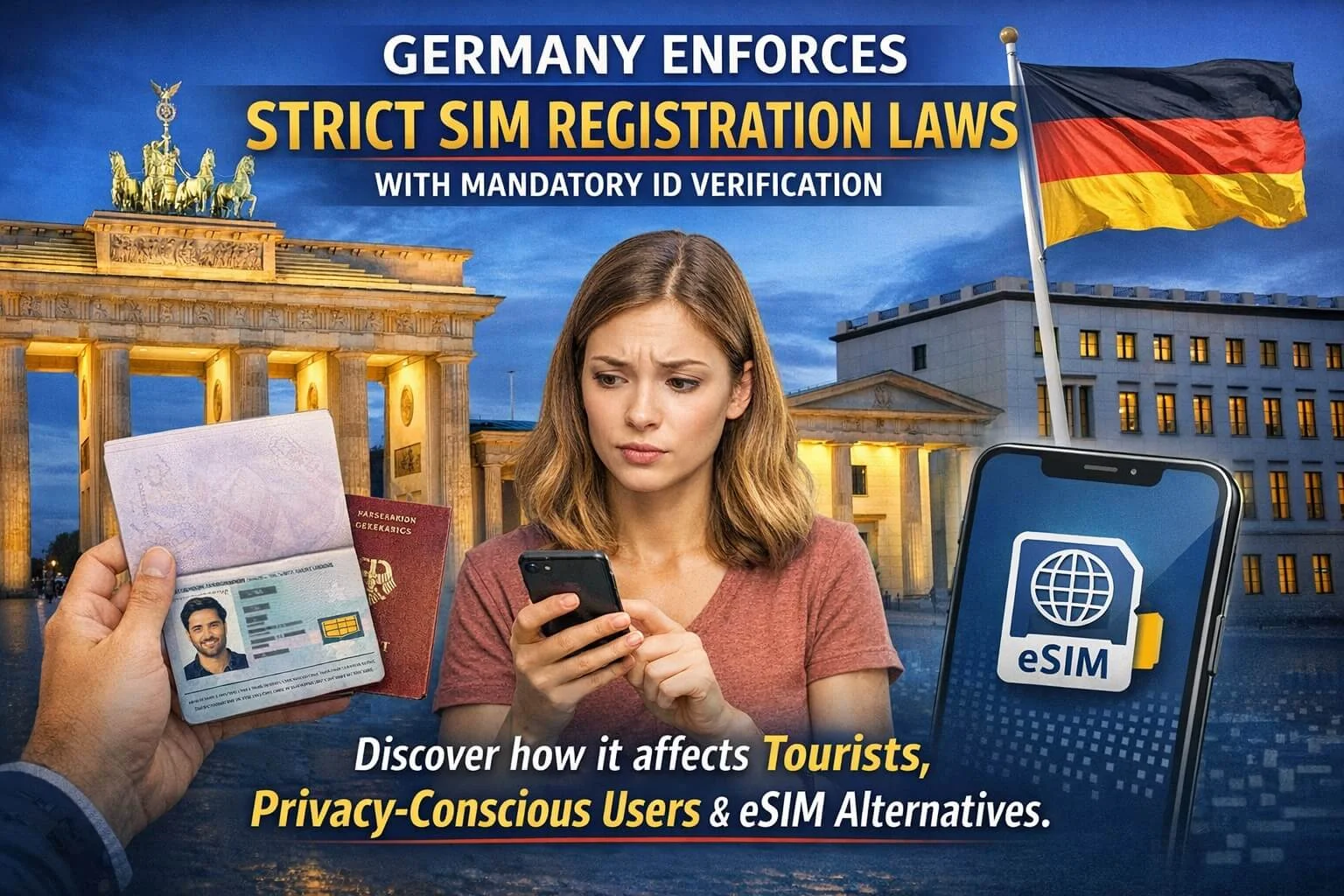
Buying a SIM card in Germany is not a casual transaction. It is a regulated process, governed by federal law and enforced by every major mobile carrier. Whether you are a tourist buying a prepaid SIM or a resident opening a contract, identity verification is mandatory.
This requirement reflects Germany’s long-standing policy of linking mobile numbers to real individuals. The stated goal is crime prevention and national security. The result is one of Europe’s most comprehensive SIM registration systems, where anonymity is not an option and every number is traceable from the moment it is activated.
For travelers and privacy-conscious users, understanding how these rules work is essential before choosing how to stay connected in Germany.
What Are SIM Registration Laws in Germany?
Germany introduced mandatory SIM registration in 2017 as part of reforms to its Telecommunications Act. The law requires all mobile connections — prepaid and postpaid alike — to be linked to a verified identity before activation.
There are no exceptions for tourists, short-term visitors, or prepaid customers. Every SIM card must be registered to a real person using an official identity document.
In practice, this means:
- No anonymous prepaid SIM cards are legal
- Activation is impossible without verification
- Carriers must store customer identity data
- Numbers are permanently linked to individuals
Germany’s approach is among the strictest in the European Union, and enforcement is uniform across all major operators.
Do You Need ID to Buy a SIM in Germany?
Yes. Without exception.
To activate a SIM card in Germany, you must present valid identification. For most travelers, this means a passport. For residents, a national ID card is typically required.
Identity verification is mandatory:
- For prepaid SIM cards
- For contract SIM cards
- For in-store purchases
- For online orders
Even if a SIM card is purchased online, activation will not occur until the identity check is completed.
Many carriers use a video identification process, where the customer must appear on a live video call and present their document to an agent. Others require in-person verification at a retail location or post office.
Activation may take minutes, hours, or sometimes longer.
Jet lag and video identification are a combination best avoided.
What Documents Are Required?
The exact documents depend on your status.
For tourists:
For EU residents:
- National identity card or passport
For German residents:
- German ID card
- Sometimes proof of address
In some cases, carriers may also request:
- Date of birth
- Current address
- Device IMEI
Copies of these documents are stored by the carrier as part of the registration process and retained under German data retention laws.
How SIM Registration Works in Practice
The process typically follows four steps.
First, the SIM card is purchased, either online or in-store.
Second, identity verification is performed. This may involve:
- In-person verification at a shop
- A video identification call
- Verification at a post office
Third, the carrier enters the identity data into its registration system and links it to the SIM number.
Finally, activation is approved and the SIM becomes usable.
If verification fails — for example, due to poor video quality or document mismatch — activation is delayed or denied.
For travelers arriving late at night, this can turn a simple task into an unexpectedly bureaucratic experience.
Why Does Germany Require SIM Registration?
The policy was introduced for security reasons.
German lawmakers argued that anonymous mobile numbers made it harder to investigate:
- Organized crime
- Fraud and financial crime
- Terrorism
- Serious criminal offenses
By linking every number to a verified identity, authorities gain the ability to trace communications back to specific individuals.
The policy reflects Germany’s historical emphasis on accountability in telecommunications.
The trade-off is privacy.
What Data Do Carriers Store?
Under German law, carriers are required to collect and retain extensive subscriber information.
Typically stored data includes:
- Full legal name
- Date of birth
- Address
- Passport or ID number
- SIM number
- Device IMEI
- Activation date
In addition, carriers retain metadata such as:
- Call logs
- Data session records
- Approximate location data
- Network usage patterns
This information may be accessed by authorities under court order and retained for years.
Even in a country known for privacy protections, telecom data remains a highly regulated and highly monitored category.
Can You Buy a SIM Without ID in Germany?
No.
There is no legal way to activate a local German SIM card without presenting valid identification.
This applies to:
- Prepaid SIMs
- Tourist SIMs
- Airport SIMs
- Online orders
Informal sellers and resellers are still required to register the SIM before activation.
The only practical way to avoid local registration is to use a SIM or eSIM issued outside Germany.
This is why many travelers choose an anonymous eSIM for Germany instead.
Are Foreign eSIMs and Roaming SIMs Exempt?
Yes.
Foreign-issued SIM cards and eSIMs are not subject to German SIM registration laws.
When you use:
- A roaming SIM from another country
- A foreign-issued eSIM
- A data-only international plan
Your identity is registered, if at all, with the foreign provider — not with a German carrier.
From the perspective of German authorities, the number belongs to a foreign network.
This legal distinction allows travelers to use anonymous or no-KYC eSIMs in Germany without entering the German SIM registry.
Privacy Implications of SIM Registration
SIM registration creates a permanent link between:
- A real identity
- A mobile number
- A physical device
- A location history
Over time, this data forms a detailed behavioral profile.
For most users, this is invisible.
For journalists, researchers, activists, business travelers, and security professionals, it is a significant consideration.
Metadata does not reveal what was said. It reveals who spoke, to whom, when, where, and how often.
That is often more than enough.
Alternatives for Privacy-Conscious Travelers
Travelers who prefer not to enter the German SIM registry have several options.
Common alternatives include:
- Foreign roaming SIM cards
- Anonymous eSIMs
- Data-only international plans
- Multi-country European eSIMs
Among these, anonymous eSIMs offer the most practical balance between privacy, cost, and convenience.
They provide:
- No local registration
- No ID verification
- Fast activation
- Full German network coverage
For a detailed guide, see Anonymous eSIM for Germany – No KYC, Secure Mobile Data.
FAQs
Is SIM registration mandatory in Germany?
Yes. All local SIM cards must be registered to a verified identity.
Can tourists buy prepaid SIMs without ID?
No. Passport verification is required for all activations.
How long is my data stored?
Retention periods vary, but identity and usage metadata may be stored for years.
Is using an anonymous eSIM legal in Germany?
Yes. Foreign-issued eSIMs are legal for tourists and residents.
Can I avoid registration by buying online?
No. Online purchases still require identity verification before activation.
Final Thoughts
Germany’s SIM registration system is efficient, comprehensive, and strictly enforced.
It is also incompatible with anonymity.
For most travelers, this is a minor inconvenience. For privacy-conscious users, it is a structural limitation that shapes every mobile connection.
Understanding these rules makes it possible to choose consciously — between convenience, cost, and privacy — before you ever step into a mobile shop.
And in Germany, that choice matters more than most people realize.