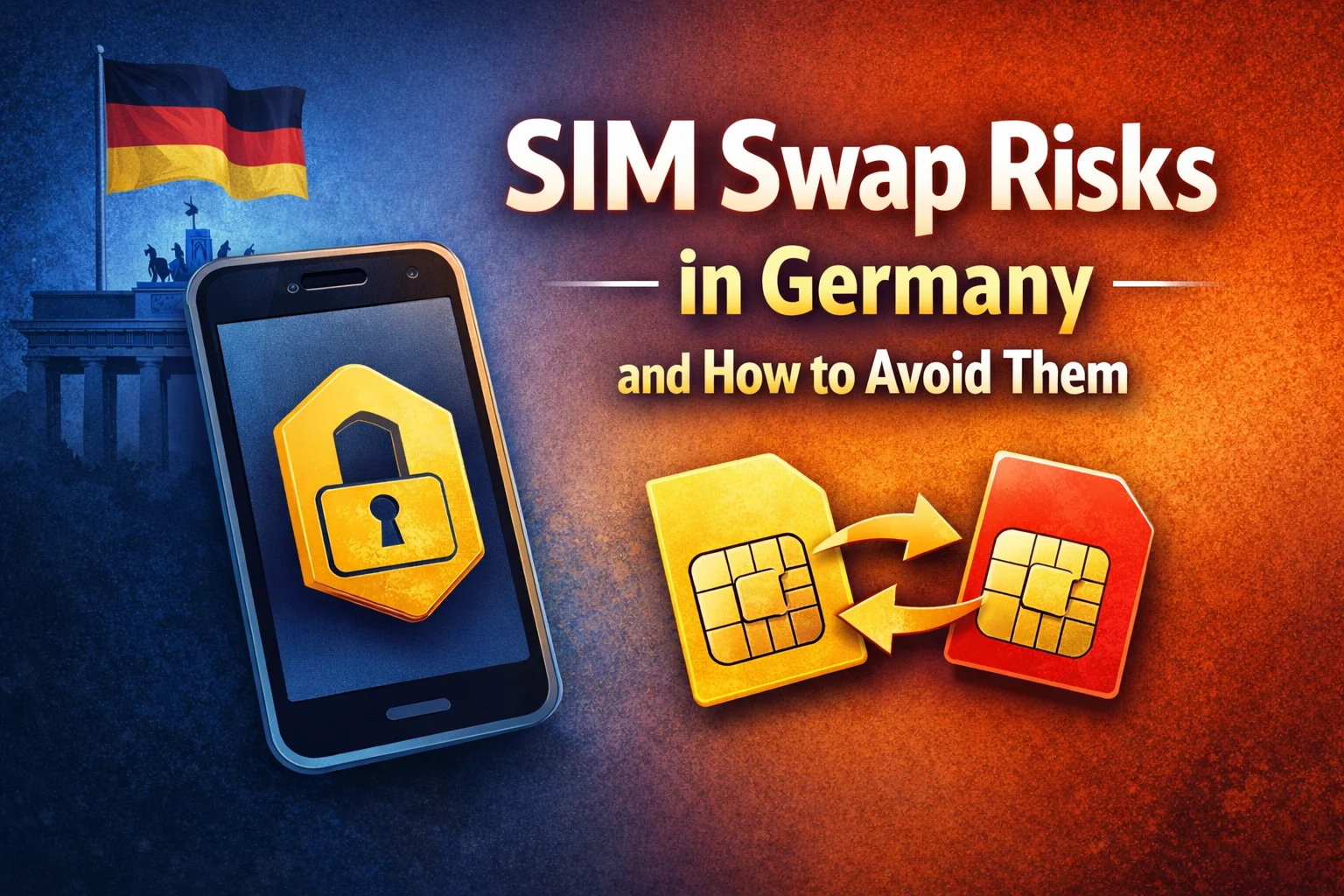
Most mobile security breaches do not begin with malware — they begin with a phone call. In Germany, where every mobile number is tightly linked to a verified identity, SIM swap attacks have become a quiet but persistent threat. With a few pieces of personal information and a convincing story, attackers can persuade a carrier to transfer a victim's number to a new SIM — and in doing so, take control of banking, email, and cloud accounts within minutes.
SIM swap is not a theoretical risk. It is a practical attack that exploits the weakest point in modern security: the human process that controls access to your phone number. Understanding how these attacks work — and how to reduce your exposure — is now part of basic digital self-defense.
What Is a SIM Swap Attack?
A SIM swap attack occurs when an attacker convinces a mobile carrier to transfer your phone number to a SIM card they control. Once the transfer is complete:
- Your phone loses service
- The attacker receives your calls and messages
- SMS-based password resets go to the attacker
- Two-factor authentication codes are intercepted
The attacker does not need your phone — they only need your number. A SIM swap does not steal a device. It steals an identity.
How SIM Swap Attacks Work in Practice
Most SIM swap attacks follow a predictable pattern. First, the attacker gathers personal information about the victim. This may come from:
- Data breaches
- Social media
- Public records
- Phishing emails
- Previous leaks
Second, the attacker contacts the victim's mobile carrier. Using social engineering, they claim:
- The phone was lost
- The SIM was damaged
- The device was stolen
- The user is traveling
Third, they request a SIM replacement or number port. If the carrier's verification process is bypassed or manipulated, the number is transferred. Finally, the attacker begins resetting accounts — bank logins, email passwords, cloud accounts, crypto exchanges. Within minutes, control cascades across the victim's digital life.
Why SIM Swap Is a Serious Risk in Germany
Germany's telecom system is both secure and centralized. Every SIM card is registered to a verified identity, every number is stored in carrier databases, and every replacement follows a formal process. This creates two conditions that attackers exploit.
First, high-value identity records. When every number is linked to a real person, that database becomes a valuable target for fraud and insider abuse. Second, predictable verification procedures. When carriers follow standardized scripts, attackers learn how to game them.
Germany also has high adoption of:
- Online banking
- SMS-based transaction verification
- Mobile TAN systems
- Mobile-based account recovery
Strong identity systems increase security — but they also increase the payoff for breaking them.
What Can Be Taken Over After a SIM Swap?
The damage rarely stops at one account. Once an attacker controls your number, they can reset access to:
- Bank and brokerage accounts
- Cryptocurrency exchanges
- Email accounts
- Cloud storage
- Social media profiles
- Corporate VPNs
- Password managers
Many recovery processes rely on the assumption that whoever controls the phone number controls the identity. That assumption is increasingly fragile. SIM swap is not an account breach — it is a platform breach.
How Common Is SIM Swap Fraud in Germany?
German banks and telecom providers rarely publish detailed statistics. What is known is this:
- Financial institutions now warn customers about SIM swap
- Banks are slowly moving away from SMS authentication
- Law enforcement treats SIM swap as organized fraud
- Crypto-related SIM swap cases are increasing
SIM swap is underreported, underpublicized, and consistently underestimated. Most victims discover the attack only after money is gone.
Warning Signs of a SIM Swap Attack
The earliest signal is usually simple: your phone loses service. Suddenly — no signal, no data, no calls, no SMS. At the same time, you may receive:
- Password reset emails
- Bank security alerts
- Login notifications
- Account lock warnings
Loss of signal is not an inconvenience — it is a security event. Treat it accordingly.
How to Prevent SIM Swap Attacks
There is no single fix — only risk reduction. Effective defenses include:
Avoid SMS-Based Two-Factor Authentication
SMS is the weakest form of 2FA. Use authenticator apps, hardware security keys, or app-based confirmations instead.
Set a Carrier Security PIN
Most German carriers allow account PINs, port-out protection, and additional verification flags. Enable them.
Minimize Public Personal Data
Attackers succeed by correlating birthdates, addresses, employer information, and social media details. Less public data means harder impersonation.
Monitor Account Alerts
Enable alerts for SIM changes, port-out requests, login attempts, and password resets. Speed matters.
How eSIM Reduces SIM Swap Risk
eSIM does not make SIM swap impossible — it changes the economics of the attack.
With a physical SIM, the attacker can request a replacement, the SIM can be reissued in-store, and physical possession often helps. With eSIM, there is no physical card to steal, reissuance is more tightly controlled, in-store replacement is harder, and account-level security matters more.
With an anonymous eSIM, risk is reduced further:
- No local carrier account
- No registered identity in German systems
- No predictable customer profile
- Smaller social engineering surface
eSIM reduces the attack surface — it does not eliminate it. Security is about layers, not miracles.
SIM Swap vs eSIM: A Security Comparison
| Feature | Physical SIM | eSIM |
| Physical theft | Possible | Not applicable |
| In-store replacement | Easy | Restricted |
| Social engineering | Common | Harder |
| Identity linkage | High | Lower with anonymous eSIM |
| Attack surface | Larger | Smaller |
Attackers choose the path of least resistance. Reducing convenience for attackers is the goal.
What to Do If You Are a Victim of SIM Swap in Germany
Time is critical. If you suspect a SIM swap:
- Contact your carrier immediately
- Suspend or lock the number
- Reset all major passwords
- Lock bank and exchange accounts
- Enable stronger authentication
- Report the incident to police
- Audit recent account activity
Assume every account tied to your phone number is compromised. Act accordingly.
Who Is Most at Risk?
SIM swap targets are not random. High-risk groups include:
- Cryptocurrency users
- Executives and business owners
- Journalists and researchers
- Activists
- High-net-worth individuals
- Anyone using SMS for account recovery
If your phone number protects valuable assets, it is a valuable target.
FAQs
What is SIM swap fraud?
It is the unauthorized transfer of your phone number to an attacker's SIM.
Is SIM swap common in Germany?
It is less visible than in some countries, but steadily increasing.
Can eSIM be SIM-swapped?
Yes, but it is harder and more controlled than physical SIM replacement.
Does changing carriers help?
It helps only if security procedures improve.
How do I protect my number best?
Avoid SMS 2FA, set carrier PINs, and minimize public data.
Final Thoughts
Germany operates one of Europe's most structured telecom systems. It is efficient, regulated — and also a single point of failure. SIM swap attacks succeed not because technology is weak, but because human processes are.
Reducing your exposure does not require paranoia. It requires understanding that in modern security, your phone number is no longer a convenience — it is a master key. And in Germany, protecting that key is now part of staying safe.